
Ultimate Kanheri Caves Travel Guide 2026 | History, Timings, Entry Fee, Trek & How to Reach
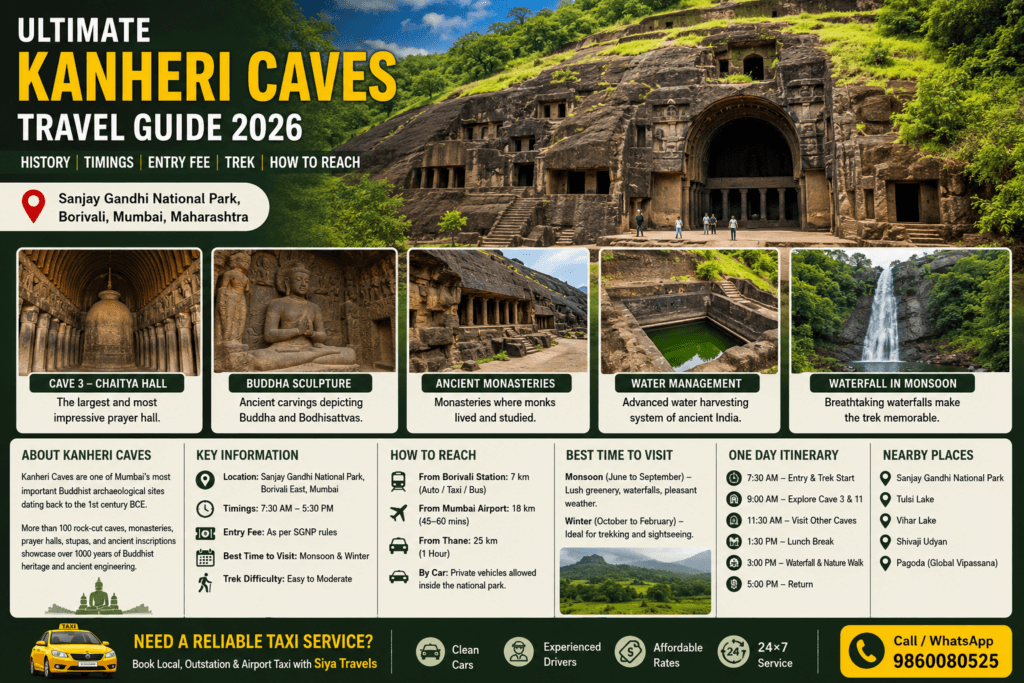
About Kanheri Caves
Kanheri Caves are one of Mumbai’s most fascinating historical and archaeological attractions. Located within Sanjay Gandhi National Park in Borivali, these ancient Buddhist rock-cut caves represent over a thousand years of Buddhist learning, meditation, architecture, and cultural development.
The cave complex consists of more than 100 excavated caves carved into basalt rock hills. These caves served as monasteries, prayer halls, educational centers, and residences for Buddhist monks from the 1st century BCE to the 10th century CE.
Today, Kanheri attracts historians, trekkers, photographers, students, nature lovers, and tourists seeking a unique blend of history, spirituality, and adventure.
Where Are Kanheri Caves Located?
Many visitors ask, “Where is Kanheri Caves located?”
The cave complex is situated inside Sanjay Gandhi National Park in Borivali East, Mumbai, Maharashtra.
Kanheri Caves Location
- State: Maharashtra
- City: Mumbai
- Area: Borivali East
- National Park: Sanjay Gandhi National Park
- District: Mumbai Suburban
- Distance from Borivali Railway Station: Approximately 7 km
- Distance from Mumbai Airport: Approximately 18 km
- Distance from Thane: Approximately 25 km
The caves are surrounded by forests, hills, waterfalls, and rich biodiversity, making them one of Mumbai’s most scenic heritage destinations.
History of Kanheri Caves
The history of this ancient Buddhist site dates back to the 1st century BCE.
The name “Kanheri” originates from the Sanskrit term Krishnagiri, meaning “Black Mountain,” referring to the dark basalt rock from which the caves were carved.
For nearly a thousand years, Buddhist monks used this location as:
- Monasteries
- Educational centers
- Meditation retreats
- Religious institutions
- Pilgrimage destinations
The cave complex flourished because it was located on an important ancient trade route connecting western India with inland regions.
Who Built Kanheri Caves?
Many travelers search for “Who built Kanheri Caves?”
The caves were not built by a single king or dynasty.
Instead, they were gradually developed by Buddhist monks, merchants, donors, and rulers over several centuries.
Several inscriptions indicate support from:
- Satavahana rulers
- Western Kshatrapas
- Local merchants
- Buddhist communities
The site evolved continuously between the 1st century BCE and the 10th century CE.
Why Are Kanheri Caves Famous?
The ancient complex is famous for:
- Buddhist heritage
- Rock-cut architecture
- Ancient inscriptions
- Water management system
- Meditation chambers
- Chaitya halls
- Stupas
- Buddha sculptures
- Rainwater harvesting structures
- Monsoon waterfalls
The site is considered one of the most important Buddhist archaeological complexes in western India.
Water Management System
One of the most remarkable features is its advanced water conservation network.
Ancient engineers created:
- Rock-cut water tanks
- Rainwater harvesting channels
- Reservoirs
- Drainage systems
These systems supplied water to monks throughout the year and remain a significant example of ancient Indian engineering.
Architecture of Kanheri Caves
The architecture reflects centuries of Buddhist artistic development.
Major features include:
Chaitya Halls
Large prayer halls used for worship and religious gatherings.
Viharas
Residential monasteries where monks lived and studied.
Stupas
Sacred Buddhist monuments representing enlightenment.
Sculptures
Beautiful carvings of Buddha, Bodhisattvas, and religious symbols.
Inscriptions
Ancient inscriptions providing valuable historical information about trade, religion, and society.
How Many Caves Are There?
The complex contains more than 100 excavated caves.
These include:
- Monasteries
- Meditation cells
- Prayer halls
- Water tanks
- Stupas
- Educational chambers
Some caves are simple residential cells, while others feature elaborate carvings and sculptures.
Most Important Caves to Visit
Cave 3
The largest and most impressive Chaitya Hall.
Features:
- Massive prayer hall
- Large stupa
- Stone pillars
- Ancient carvings
Cave 11
Known for Buddhist sculptures and monastery structures.
Cave 34
Contains important inscriptions and architectural elements.
Cave 41
Famous for its Buddha image and artistic details.
Cave 90
Known for Buddhist carvings and religious significance.
Kanheri Caves Timings
Opening Hours
- Opening Time: 7:30 AM
- Closing Time: 5:30 PM
Visitors should arrive early to enjoy cooler temperatures and fewer crowds.
Entry Fee
Indian Citizens
As per Sanjay Gandhi National Park regulations.
Foreign Tourists
Separate charges may apply.
Children
Discounted entry according to park rules.
Visitors should verify the latest ticket prices before travel.
How to Reach Kanheri Caves
From Borivali Railway Station
Distance: Approximately 7 km
Options:
- Auto-rickshaw
- Taxi
- SGNP shuttle services
- Cycling inside the park
From Mumbai Airport
Distance: Approximately 18 km
Travel Time: Around 45–60 minutes depending on traffic.
From Thane
Distance: Approximately 25 km
Travel Time: Around 1 hour.
By Car
Private vehicles are permitted inside Sanjay Gandhi National Park subject to park regulations.
Trek to Kanheri Caves
The destination is popular among trekking enthusiasts.
Trek Difficulty
Easy to Moderate
Best Trek Season
- Monsoon
- Post-Monsoon
- Winter
The surrounding forest trails become especially beautiful during the rainy season.
Kanheri Caves in Monsoon
Monsoon is considered the best season to visit Kanheri Caves. During the rainy season, the surrounding forests of Sanjay Gandhi National Park become lush green, creating a breathtaking landscape around the ancient Buddhist caves.
Temporary waterfalls appear across the rocky cliffs, making the site a favorite destination for photographers and nature enthusiasts. The cool weather and mist-covered hills enhance the overall experience.
Visitors should carry:
- Raincoat or umbrella
- Non-slip trekking shoes
- Drinking water
- Camera for photography
The monsoon season usually lasts from June to September and offers the most scenic views around the cave complex.
Kanheri Caves Waterfall
One of the major attractions during the rainy season is the Kanheri Caves Waterfall.
The waterfall flows naturally through the hills surrounding the cave complex and attracts thousands of visitors every monsoon. The combination of ancient Buddhist architecture and seasonal waterfalls creates a unique travel experience rarely found in metropolitan cities.
The waterfall is usually most active between July and September.
Best Time to Visit Kanheri Caves
October to February
Pleasant weather and comfortable sightseeing conditions.
June to September
Monsoon greenery and waterfalls.
March to May
Warmer temperatures but fewer crowds.
Most travelers prefer visiting during monsoon or winter.
One Day Kanheri Caves Itinerary
Morning
08:00 AM – Reach Sanjay Gandhi National Park
08:30 AM – Begin journey toward Kanheri Caves
09:00 AM – Explore Cave 3
10:00 AM – Visit major Buddhist caves
11:30 AM – Explore inscriptions and sculptures
Afternoon
01:00 PM – Lunch break
02:00 PM – Visit waterfall areas
03:00 PM – Photography and nature walk
04:30 PM – Return to Borivali
Nearby Places to Visit
While visiting Kanheri Caves, tourists can also explore:
- Sanjay Gandhi National Park
- Global Vipassana Pagoda
- Gorai Beach
- EsselWorld Area
- Mahakali Caves
- Juhu Beach
- Gateway of India
- Elephanta Caves
- Marine Drive
- Bandra Bandstand
Kanheri Caves Photography Guide
Kanheri Caves are among Mumbai’s best photography locations.
Popular photography subjects include:
- Ancient Buddhist sculptures
- Chaitya halls
- Rock-cut architecture
- Monsoon waterfalls
- Forest landscapes
- Sunrise photography
- Wildlife around the national park
Visitors should respect ASI guidelines and avoid touching carvings.
Why Visit Kanheri Caves?
Kanheri Caves offer a rare combination of:
✔ Ancient Buddhist heritage
✔ More than 100 rock-cut caves
✔ Historical inscriptions
✔ Advanced water management system
✔ Monsoon waterfalls
✔ Easy access from Mumbai
✔ Scenic trekking trails
✔ Educational value
✔ Photography opportunities
✔ Family-friendly destination
What are the caves?
These are ancient Buddhist rock-cut monuments located inside Sanjay Gandhi National Park in Mumbai, Maharashtra. The site contains over 100 caves used as monasteries, prayer halls, and learning centers.
Where is this Buddhist cave complex located?
The site is located in Borivali East, Mumbai, inside Sanjay Gandhi National Park in Maharashtra, India.
Which city is this heritage site located in?
The cave complex is located in Mumbai, Maharashtra.
Which state is the monument located in?
The attraction is located in the Indian state of Maharashtra.
Who built this cave complex?
The site was developed by Buddhist monks, merchants, and patrons over several centuries between the 1st century BCE and the 10th century CE.
Who constructed these caves?
The caves were gradually excavated by Buddhist communities with support from traders and local rulers.
Which dynasty supported the development of the site?
The monument flourished under the Satavahana rulers and later received support from various dynasties and merchants.
How old is this cave complex?
The site is over 2,000 years old, with the earliest caves dating back to the 1st century BCE.
How many years old is the monument?
The oldest sections are approximately 2,100 years old.
Why is this Buddhist site famous?
It is renowned for Buddhist architecture, ancient inscriptions, chaitya halls, monasteries, and a sophisticated rainwater harvesting system.
What is special about this heritage attraction?
The site contains over 100 excavated structures, ancient water management systems, Buddhist sculptures, and one of the largest chaitya halls in western India.
How many caves are there?
The complex contains more than 100 rock-cut caves.
What can visitors see inside?
Visitors can explore monasteries, prayer halls, stupas, Buddha sculptures, inscriptions, meditation chambers, and water tanks.
What religion is associated with the site?
The monument is associated with Buddhism and served as an important Buddhist monastic center.
Is this site Buddhist?
Yes. The entire complex is dedicated to Buddhist heritage and culture.
What is Cave 3 famous for?
Cave 3 is the largest chaitya hall in the complex and features a large stupa, impressive pillars, and detailed carvings.
What are the visiting timings?
The attraction is generally open from 7:30 AM to 5:30 PM.
What time does the site open?
The monument usually opens at 7:30 AM for visitors.
What time does the site close?
The attraction generally closes at 5:30 PM.
Are the caves open today?
The site is normally open every day during official visiting hours. Visitors should verify timings before travel.
Is the monument open on Monday?
Yes, the attraction is generally open on Mondays unless special restrictions apply.
How can visitors reach the caves?
Visitors can reach the site via Borivali Railway Station and then travel through Sanjay Gandhi National Park by bus, taxi, private vehicle, or bicycle.
How can I reach the site from Borivali Station?
The attraction is around 7 km from Borivali Station and can be reached by park buses, auto-rickshaws, taxis, or private vehicles.
How can I reach the monument from Mumbai Airport?
The site is approximately 18 km from Mumbai Airport and can be reached by taxi in about 45–60 minutes depending on traffic.
How far is the attraction from Borivali Station?
The distance is approximately 7 km.
How far is the site from Mumbai Airport?
The monument is approximately 18 km from Chhatrapati Shivaji Maharaj International Airport.
How much time is required for a visit?
Most visitors spend 2–4 hours exploring the caves and surrounding forest area.
How long is the trek?
The trek is generally easy to moderate and varies depending on the route taken within Sanjay Gandhi National Park.
Is the trek difficult?
No. The trekking route is considered easy to moderate and suitable for beginners and families.
What is the best time to visit?
The best time to visit is during monsoon and winter, from June to February.
Can I visit during monsoon?
Yes. Monsoon is one of the most popular seasons because of the greenery and waterfalls around the site.
Is there a waterfall nearby?
Yes. Seasonal waterfalls appear around the cave complex during the monsoon season.
What is the ancient water management system?
The monument features rainwater harvesting systems, reservoirs, channels, and rock-cut water tanks used by Buddhist monks.
Is photography allowed?
Yes. Photography is generally allowed for personal use, though visitors should follow park and ASI regulations.
Are drones allowed?
No. Drone photography is generally prohibited without official permission.
Is parking available?
Yes. Parking facilities are available inside Sanjay Gandhi National Park.
Are food facilities available nearby?
Basic food stalls and refreshments are available within the national park area.
Is this attraction worth visiting?
Yes. It is one of Mumbai’s most important historical and archaeological attractions.
What nearby places can tourists explore?
Nearby attractions include Sanjay Gandhi National Park, Global Vipassana Pagoda, Gorai Beach, Juhu Beach, and Elephanta Caves.
Who discovered the caves?
The site was known locally for centuries and has been documented by historians and archaeologists since the colonial period.
What does the name mean?
The name originates from the Sanskrit word Krishnagiri, meaning “Black Mountain.”
What is this ancient Buddhist site famous for?
The attraction is famous for Buddhist heritage, rock-cut architecture, chaitya halls, inscriptions, water conservation systems, and monsoon scenery.
Is the site suitable for families?
Yes. The destination is suitable for families, students, photographers, trekkers, and history enthusiasts.
Is the monument safe to visit?
Yes. The site is generally safe for visitors, provided standard safety precautions are followed.
What is the nearest railway station?
Borivali Railway Station is the nearest major railway station.
What is the nearest metro station?
Several Mumbai Metro stations provide access to Borivali and nearby areas from where visitors can continue to the caves.
Related Travel Guides
- Maharashtra Tourist Places
- Ajanta Caves Travel Guide
- Ellora Caves Travel Guide
- Elephanta Caves Travel Guide
- Bhaja Caves Travel Guide
- Top Tourist Places in Aurangabad
- Ajanta Ellora Travel Guide
- Tour Packages From Aurangabad
- Outstation Taxi Service
- Taxi Booking Aurangabad
- Best Cab Service in Aurangabad
- Aurangabad Taxi Service
Conclusion
Kanheri Caves are one of Mumbai’s most important historical landmarks and among India’s finest examples of Buddhist rock-cut architecture. With over 100 caves, ancient inscriptions, advanced water conservation systems, scenic trekking routes, and seasonal waterfalls, the site offers a memorable experience for every traveler.
Whether you are interested in history, spirituality, architecture, trekking, photography, or nature, Kanheri Caves deserve a place on your Maharashtra travel itinerary.
Book Comfortable Taxi Service with Siya Travels
Planning to explore Kanheri Caves, Mumbai sightseeing, or Maharashtra tourist destinations? Siya Travels offers reliable taxi services, outstation cabs, airport transfers, and customized tour packages.
✔ Clean Vehicles
✔ Experienced Drivers
✔ Family Tours
✔ Maharashtra Sightseeing Packages
✔ 24×7 Booking Support
Call / WhatsApp: 9860080525
Website: www.siyatravels.com